
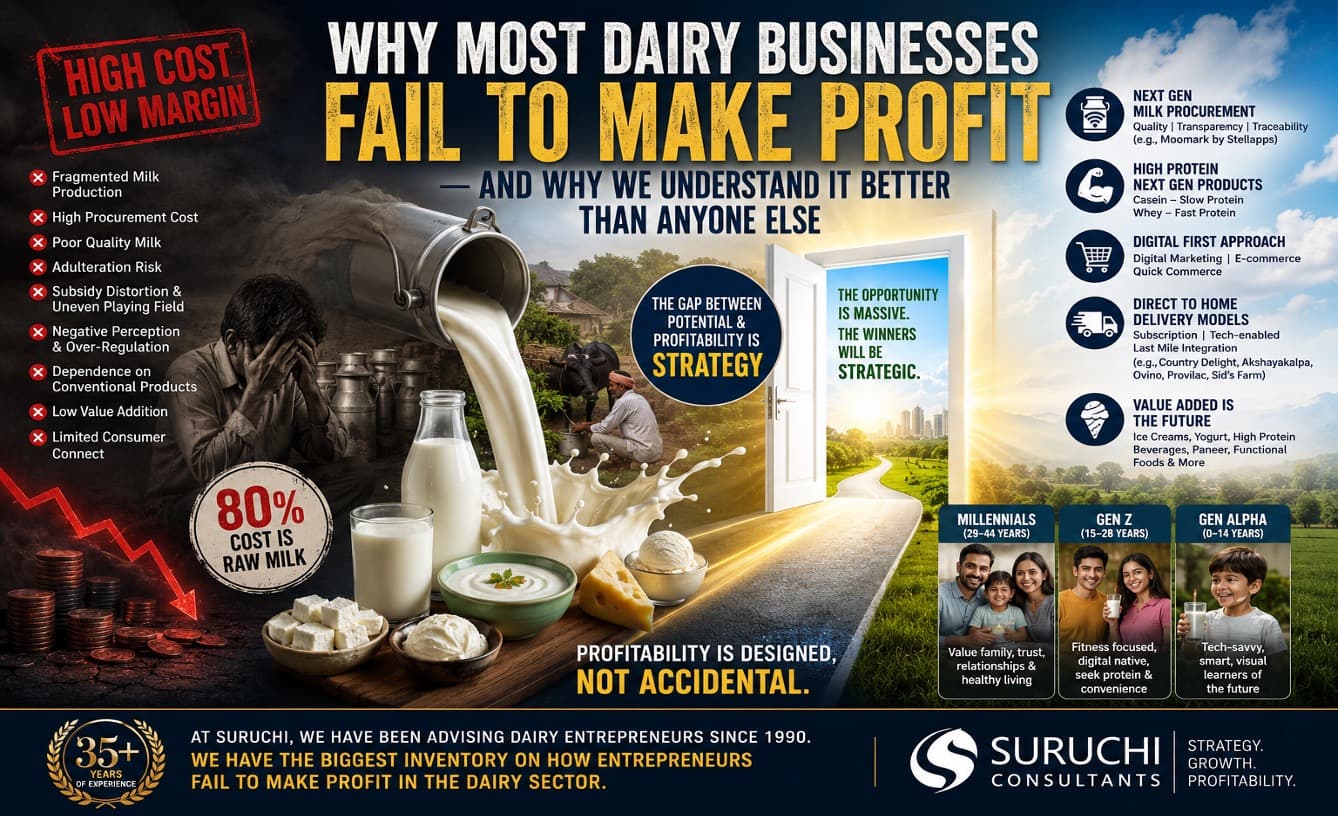
For more than three decades, India’s dairy sector has been seen as one of the safest sectors for investment. Milk is consumed daily, demand keeps rising, India is the world’s largest milk producer, and dairy products are deeply embedded into Indian food culture.
Yet the harsh reality is that profitability in the dairy sector remains one of the most difficult equations to solve.
At Suruchi Consultants, while working with dairy entrepreneurs, dairy plants, cooperatives, startups, investors and food businesses since 1990, we have probably built one of the country’s largest practical inventories of why dairy entrepreneurs fail to make profits. The sector looks simple from outside, but internally it is among the most operationally complex businesses in India.
Over the last 2–3 years, quarterly results of several listed and large dairy companies with value added products like Heritage foods , Dodla Dairy , Hatsun Agro, Milymist and Parag Milk foods , covered by DairyNews7x7 have repeatedly shown the same pattern — revenues may grow, brands may expand, but whenever milk procurement prices rise sharply, margins immediately come under pressure.
The reason is simple.
In dairy, almost 75–80% of the total cost structure depends upon one single raw material — milk.
And unlike other industries, this raw material is not procured from a few organised suppliers. It is collected every single day from millions of small farmers scattered across thousands of villages.
The Biggest Challenge: Milk Procurement Economics
India’s milk production ecosystem is highly fragmented. A dairy processor may have to travel village after village to collect merely a few hundred litres of milk from each location. Lower animal productivity further increases the procurement cost because the quantity available for lifting remains limited.
This means a dairy company has to continuously invest in:
Village collection systems
Chilling infrastructure
Transportation logistics
Quality testing
Procurement manpower
Farmer engagement
Extension services
Milk procurement is therefore not just sourcing. It is a complete rural supply chain management system.
But quantity alone is not enough.
Milk is the single raw material for the entire dairy industry. If the quality of milk is poor, no dairy plant can manufacture superior curd, paneer, butter, cheese, yogurt, whey beverages or nutritional products. Poor raw milk quality directly affects shelf life, processing efficiency, wastage, consumer trust and finally profitability.
This is precisely why next generation milk procurement systems are becoming critically important for the future of the dairy industry.
Companies like MooMark are creating technology-driven procurement ecosystems where milk quality, transparency, traceability and farmer connectivity can be monitored in real time. Such systems not only help in procuring better quality milk from farmers but also create the operational backbone required for high-quality value added dairy processing.
The future profitability of dairy businesses will increasingly depend upon technology-led procurement efficiency rather than merely expanding plant capacities.
The Structural Contradictions of the Dairy Sector
The second major issue in dairy profitability is that the Indian dairy sector does not always operate on a level playing field.
In many states, state dairy federations provide direct milk subsidies or incentives to farmers supplying milk to their unions. Simultaneously, these federations often sell liquid milk and curd at highly competitive consumer prices.
This creates enormous pressure on private dairy companies, startups and even Farmer Producer Organisations (FPOs), because they have to compete against subsidised procurement systems as well as subsidised market pricing.
In several regions, independent dairy cooperative structures outside the federation ecosystem also face practical limitations in scaling their operations. This restricts competition and slows down innovation in milk procurement models.
Whenever organised dairies fail to procure directly and become dependent upon aggregators, the risks of adulteration increase substantially. And unfortunately, the dairy sector remains one of the easiest “soft targets” for media sensationalism and non-scientific social media narratives.
Milk and dairy products are frequently criticised without scientific understanding, creating unnecessary fear among consumers. This eventually increases regulatory scrutiny as well. Since dairy products are consumed daily by millions of households, regulators naturally maintain very high sensitivity toward the sector.
At the market level too, liquid milk in pouches, retail curd cups and buttermilk categories continue to be dominated largely by state dairy federations in many parts of India. Private sector participation remains relatively stronger in paneer, institutional curd packs, HoReCa supplies and value-added dairy products.
However, southern India and Maharashtra have clearly demonstrated that large dairy companies can still build strong private brands in liquid milk and retail curd when procurement strength, brand trust and operational efficiency work together strategically.
The Real Opportunity Lies Beyond Conventional Dairy
Despite all these challenges, the future opportunities in dairy are perhaps stronger than ever before.
Post-COVID, immunity and health became central themes in consumer behaviour. Protein emerged as one of the biggest nutritional priorities for both youth and elderly populations.
And dairy naturally fits into this transformation because it offers both:
Casein protein — slow protein suitable for sustained nutrition and functional food applications
Whey protein — fast protein increasingly preferred by younger and fitness-oriented consumers
This is where the future product mix of dairy businesses is changing rapidly.
The industry can no longer survive only on conventional milk, ghee or commodity products. The future lies in:
High protein beverages
Functional dairy nutrition
Greek yogurt and yogurt drinks
Ice creams
Whey-based products
High protein curd
Premium paneer
Functional dairy foods
Nutritional snacking
And this opportunity is being shaped by three generations simultaneously.
Millennials (29–44 years)
Millennials are today’s primary earning and decision-making generation. They value family, trust, relationships and healthier lifestyles. They seek safe, nutritious and reliable dairy products for themselves and their children.
Gen Z (15–28 years)
Gen Z is highly digital, fitness-conscious and experimental. They are more attracted toward protein positioning, convenience, lifestyle products and functional nutrition rather than conventional dairy messaging.
Gen Alpha (0–14 years)
Gen Alpha is growing up in a completely digital ecosystem. They learn from screens faster than from books, are highly tech-savvy and will redefine food branding, nutritional communication and purchasing behaviour in the coming decade.
This changing consumer landscape means that dairy businesses must now think beyond traditional distribution.
The Next Generation Dairy Business Model
The future dairy model will not be built merely on general trade distribution or conventional “mom and pop” retail deliveries.
Strategically, dairy companies now need:
Strong digital marketing
Quick commerce integration
E-commerce presence
Direct-to-home subscription systems
Consumer engagement platforms
Data-driven delivery systems
The most successful emerging models are integrating technology, nutrition positioning and direct consumer connectivity together.
Companies such as Country Delight, Akshayakalpa Organic, Ovino, Provilac and Sid\\\'s Farm have demonstrated how next generation delivery-led dairy systems can create direct consumer trust and premium positioning.
The future profitability of the dairy sector therefore lies far more in value-added products than in conventional commodity products.
Needless to say, segments such as:
Ice creams
Yogurt
High protein beverages
Premium curd
Functional dairy foods
Paneer
Nutritional dairy products
are still significantly underpenetrated and could define the next phase of growth for the Indian dairy industry.
The Strategic Reality
The Indian dairy sector is entering a transition phase where traditional business models alone may no longer ensure profitability.
The companies that will succeed in the coming decade will be those who:
Build efficient procurement ecosystems
Invest in milk quality
Use technology-led procurement systems
Create high protein and functional dairy portfolios
Build direct consumer connectivity
Leverage digital marketing aggressively
Integrate quick commerce and e-commerce
Focus on value-added products rather than commodity volumes
At Suruchi Consultants, we have been advising dairy entrepreneurs and food businesses since 1990. Over these decades, we have seen not only successful dairy ventures but also the largest reasons why dairy entrepreneurs fail to make profits.
And perhaps that understanding itself has become our biggest strength.
Because in dairy, profitability is never accidental.
It is designed strategically — from the village milk collection point to the consumer’s dining table.
So what are you waiting for Click here to contact us