
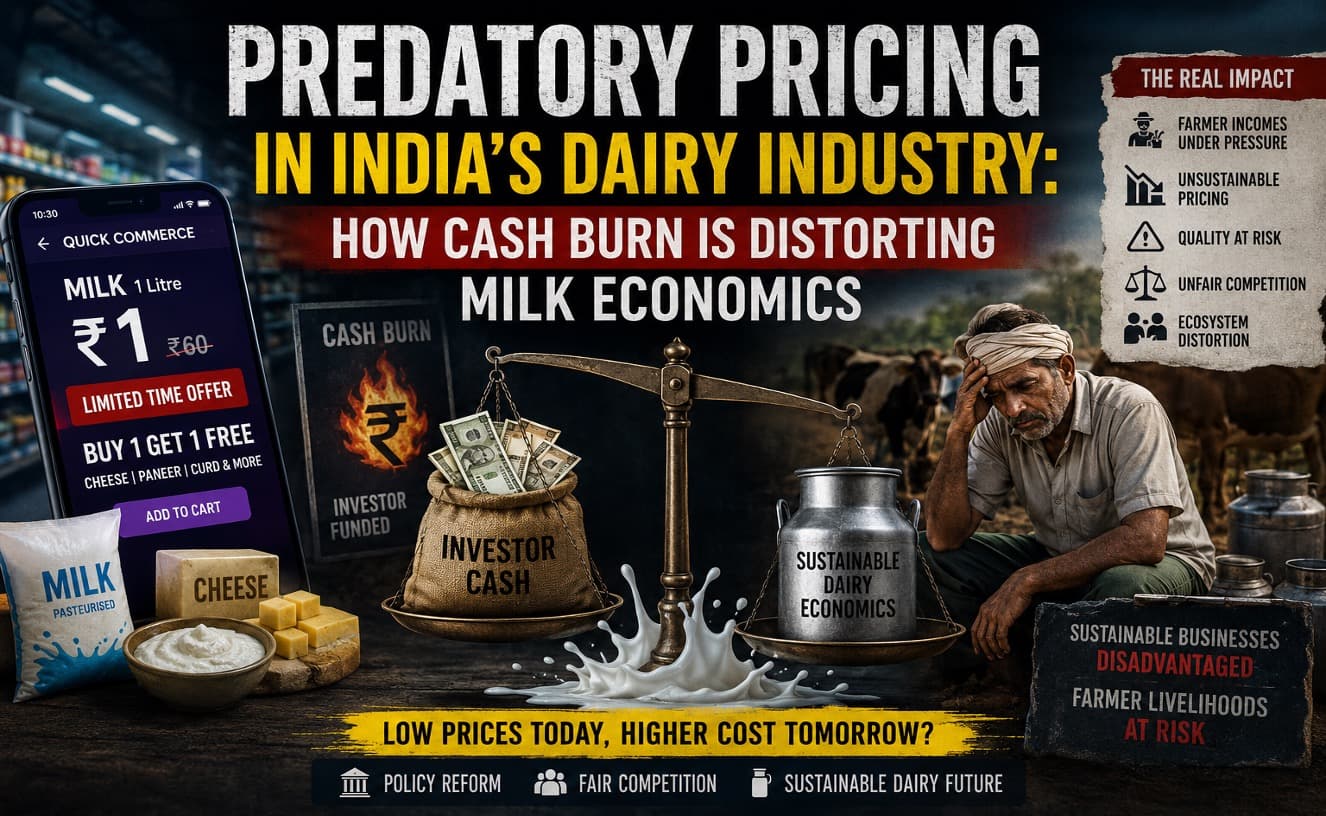
The recent controversy around milk being sold at Re 1 on a quick-commerce platform in Bengaluru may appear at first glance like an aggressive promotional campaign or a festive customer acquisition strategy. Yet beneath the surface, it raises a far deeper and far more uncomfortable question for India’s dairy ecosystem, policymakers, cooperatives, ethical businesses and even consumers themselves.
Can essential nutrition products like milk become instruments of investor-funded cash burn economics without eventually distorting the entire ecosystem built around them?
The strong reactions from Karnataka’s cooperative ecosystem, particularly institutions linked with Nandini and BAMUL, were therefore not merely emotional responses to one promotional campaign. They reflected a growing anxiety within the food sector that the rules of competition themselves may now be changing in ways that farmer-linked institutions and sustainably run dairy businesses may no longer be able to withstand. The matter even sparked discussions around unfair pricing practices and competitive distortion at a larger policy level.
Milk is not a fashion accessory. It is not a gadget. It is not an impulse luxury category. Milk is a daily nutritional necessity linked directly with millions of farmers, procurement systems, cattle economics, cold chains, village-level livelihoods and food security. The economics of dairy operate on extremely thin margins and enormous operational discipline. Every rupee of discount somewhere in the chain ultimately has to be absorbed by someone — either the farmer, the processor, the distributor, the retailer, the investor or eventually the consumer himself.
This is where the larger policy debate truly begins.
The New Economics of Cash Burn and Market Capture
Over the last decade, India has witnessed the rapid rise of investor-funded platform businesses where market share often takes precedence over profitability. In many sectors, businesses have been encouraged to “burn cash” in order to acquire customers, dominate categories and create future valuation potential. The underlying assumption has been that scale first and profitability later is an acceptable business philosophy in a digitally expanding economy.
This model may work in discretionary consumption categories. However, when the same philosophy enters essential food categories such as milk, curd, paneer, cheese and infant nutrition, the consequences become far more complex and sensitive.
Today consumers are increasingly becoming accustomed to unusually deep discounting and “buy one get one free” offers across dairy categories on quick-commerce and e-commerce platforms. Cheese, paneer, flavored milk, ice cream and even fresh milk are frequently being used as traffic-building products to attract customer attention and app loyalty. While promotional campaigns are not new to retail, the frequency and intensity of discount-led visibility in essential food categories is raising serious questions around sustainable pricing discipline and long-term market behaviour.
If a business is repeatedly able to sell below sustainable economics because losses are continuously absorbed by external investor capital, does the market continue to remain truly fair for businesses operating on real cash flows and sustainable margins?
This question deserves serious national attention.
Milk Is Not Merely a Product. It Is an Ecosystem.
India’s dairy economy is perhaps one of the world’s most socially sensitive market systems. Unlike many industries where disruption affects only corporate balance sheets, disruption in dairy pricing eventually reaches villages, cattle owners and small farmers.
A cooperative or ethical dairy processor cannot arbitrarily destroy pricing discipline for prolonged periods because it remains accountable to milk procurement realities, farmer payments, chilling infrastructure, transportation costs, working capital cycles and product quality standards. Their survival depends on balancing sustainability across the chain.
However, businesses backed by large pools of investor capital may often have a very different objective. Their priority may not necessarily be immediate profitability or long-term ecosystem balance. In many cases, valuation growth, customer acquisition and market dominance become the primary metrics.
The danger emerges when this capital-driven pricing behaviour gradually begins to reset consumer expectations themselves.
Once consumers become accustomed to seeing milk at Re 1 or cheese under perpetual “free” schemes, normal sustainable pricing starts appearing expensive even if it is economically justified. Over time, consumers stop differentiating between quality, procurement ethics, farmer linkage or nutritional integrity. Price alone becomes the visible decision parameter.
This is perhaps the most dangerous long-term impact of investor-funded discounting in food categories.
Are Ethical Businesses Being Forced Into Defensive Discounting?
Many traditional dairy businesses today privately admit that they are increasingly under pressure to participate in discount-led visibility battles merely to remain relevant on digital shelves. In several cases, businesses with far superior quality systems, farmer relationships and operational ethics are finding themselves commercially disadvantaged against players willing to absorb large financial losses for extended periods.
This slowly creates a race to the bottom.
Businesses focused on sustainable operations begin compromising margins. Procurement stress increases. Pressure builds on product formulations. Brand positioning weakens. Eventually, quality itself risks becoming secondary to visibility and discounting.
In several categories today, businesses focused on sustainable procurement, farmer payments and product quality increasingly find themselves competing not merely against operational efficiency, but against investor-funded balance sheets capable of subsidizing prolonged losses. This fundamentally alters the nature of competition itself.
Ironically, this entire cycle may initially appear pro-consumer while silently damaging the very ecosystem that ensures long-term nutritional reliability and farmer sustainability.
India must therefore ask itself honestly — are we creating a food economy driven by efficiency and sustainability, or merely one driven by investor-funded temporary affordability?
What Happens When Consumers Start Valuing Only Discounts?
Perhaps one of the least discussed consequences of prolonged deep discounting is the gradual psychological shift it creates among consumers themselves.
Repeated exposure to “free,” “flash sale” and “ultra-low-price” campaigns slowly conditions consumers to view dairy products as interchangeable commodities where only visible price matters. Brand trust, procurement ethics, farmer sustainability, nutritional integrity and even product quality begin losing importance.
At the same time, the pressure to deliver fresh dairy products within extremely compressed timelines raises new operational challenges around refrigeration integrity, handling and cold-chain discipline. Across social media and consumer forums, there have increasingly been anecdotal complaints around spoilage and dairy quality issues in hyper-speed delivery models. While such complaints should not be treated as conclusive evidence against any platform, they nevertheless indicate the growing operational pressures emerging when highly perishable nutrition products become instruments of speed-driven commerce.
The concern is not innovation. The concern is whether valuation-driven economics can eventually overpower sustainability-driven economics in essential nutrition categories.
Did India Earlier Have a Stronger View on Unfair Trade Practices?
An interesting dimension of this debate lies in India’s own regulatory history.
Under the earlier MRTP (Monopolies and Restrictive Trade Practices) framework, there existed a far stronger philosophical concern around unfair trade practices, restrictive market behaviour and pricing distortions. Over time, India’s competition framework evolved toward a more liberalized and consumer-benefit-oriented structure where lower prices themselves often came to be viewed positively unless direct abuse of dominance could be established.
However, the platform economy and investor-funded digital commerce models have now introduced an entirely new dimension into competition economics.
Concerns around predatory pricing are not entirely new in India. Even policymakers and industry bodies have periodically raised concerns over whether deep discounting funded by external capital may distort fair competition and weaken traditional retail ecosystems. Similar concerns have repeatedly surfaced across food delivery, e-commerce and quick-commerce sectors over the last few years.
Globally too, regulators have increasingly debated whether prolonged below-cost pricing supported by investor capital can distort healthy competition and eliminate sustainable businesses over time. The debate around Amazon and large platform-led businesses in the United States and Europe has repeatedly triggered discussions around predatory pricing, platform dominance and the future sustainability of traditional retail ecosystems.
The debate is no longer restricted to monopolies in the conventional sense. It now includes algorithms, platform control, investor-funded market capture and below-cost digital pricing strategies.
India may therefore need to revisit an important policy question.
Should essential fresh food categories be treated differently from discretionary consumption categories when it comes to prolonged deep discounting and cash-burn-led pricing strategies?
Should Milk and Essential Food Categories Receive Special Regulatory Attention?
This is not an argument against innovation. India certainly needs modern retail systems, digital convenience, supply-chain efficiency and technology-led commerce. Nor is this an argument against startups or entrepreneurship. Many startups are genuinely building valuable ecosystems and solving real inefficiencies.
The real concern emerges when essential nutrition categories become battlegrounds for capital-driven customer acquisition wars.
Milk occupies a unique place in India’s food economy. It impacts nutrition, inflation, farmer livelihoods and daily household economics simultaneously. Unlike electronics or fashion, prolonged pricing distortions in milk can create ripple effects across the agricultural ecosystem itself.
Many countries historically imposed stronger scrutiny on pricing distortions in agricultural and essential food systems because prolonged instability in these sectors eventually impacts not just businesses, but nutrition security, rural livelihoods and national economic resilience. India may therefore need to examine whether milk and fresh food categories deserve a differentiated policy lens compared to discretionary retail products.
Perhaps the time has come for policymakers, regulators and industry stakeholders to openly debate whether fresh essential food categories require a different framework for evaluating prolonged below-cost discounting.
Should there be greater transparency around subsidy-led pricing? Should platform-led discount structures in essential foods be monitored differently? Should unfair trade practice principles evolve to reflect the realities of investor-funded digital commerce? Should sustainable businesses and farmer-linked institutions be protected from prolonged artificial price distortion?
These are uncomfortable questions. But they are necessary questions.
The Real Debate Is About Sustainability, Not Discounts
Consumers undoubtedly deserve affordability. Innovation should absolutely reduce inefficiencies. Technology should certainly improve access and convenience.
But the long-term health of India’s dairy ecosystem cannot be evaluated only through temporary discount banners and customer acquisition campaigns.
Somewhere between investor enthusiasm, valuation battles and quick-commerce growth, India must ensure that sustainability, farmer economics, nutritional integrity and fair competition do not become invisible casualties.
The real question therefore is not whether consumers deserve lower prices.
The real question is whether temporary investor-funded affordability should be allowed to permanently distort the economics of essential nutrition categories that millions of farmers and consumers depend upon every single day.
An article by Kuldeep Sharma Founder Suruchi Consultants May 26th 2026